
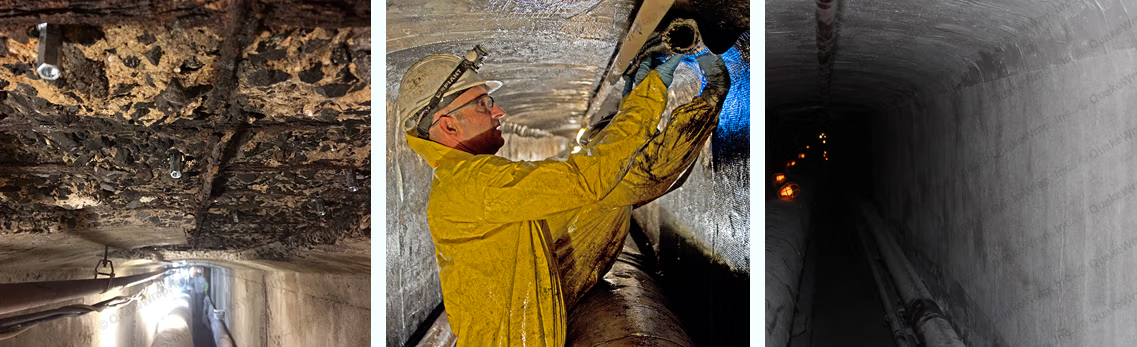
Utility Tunnel Repair
Utility tunnels are commonly used in large government, university, and medical campuses to house critical infrastructure. These concrete tunnels—often extending for long distances with cross sections of approximately 7 ft × 7 ft (2 m × 2 m)—contain water lines, hot water pipes, compressed air and gas lines, as well as communication and fiber-optic cables. Because they are located underground, these tunnels are susceptible to groundwater infiltration. Combined with limited ventilation, the resulting hot and humid environment can accelerate corrosion of the reinforcing steel within the concrete.
Access to utility tunnels is typically provided through a limited number of access ports or manholes that may be several hundred feet apart. In addition, numerous pipes and conduits mounted along the tunnel walls restrict access, making conventional repair methods using steel and concrete difficult, costly, and time-consuming.
Carbon and glass fiber-reinforced polymer (FRP) fabrics provide an efficient solution for strengthening and rehabilitating these tunnels. Deteriorated concrete is first removed and surfaces can be restored using materials such as shotcrete or gunite where necessary. The FRP fabric is saturated with resin outside the access port and passed through to installation crews inside the tunnel, who apply the material to the walls and ceiling. QuakeWrap engineers develop repair designs based on the existing structural capacity, the extent of corrosion, and any anticipated future loads. Sealed design calculations and drawings can be provided to support the rehabilitation project.
Features & Benefits
Advantages of repair of utility tunnels with FRP include:
- All repairs are trenchless, requiring zero excavation
- Walls and ceiling can be strengthened above original limits
- Flexible FRP fabric makes installation inn tight spaces possible
- Minimal increase in wall thickness (typically ¼ inch (5mm))